
Petra consumes only two goods, pizza (PP) and hamburgers (HH) and considers them to be perfect substitutes, as shown by his utility function: U(P,H)=P+4HU(P,H)=P+4H. The price of pizza is $3 and the price of hamburgers is $6, and Paul’s monthly income is $300.
Petra consumes only two goods, pizza (P) and hamburgers (H) and considers them to be perfect substitutes, as shown by his utility function: U(P,H)=P+4H. The price of pizza is $3 and the price of hamburgers is $6, and Paul’s monthly income is $300.
a. Write the equation for Petra’s budget line.
b. If hamburgers is on the vertical axis, what is the slope of the budget line?
c. Graph Petra’s budget line. Place the hamburgers servings on the vertical axis and pizza on the horizontal axis. Make sure to indicate the values of where the budget line hits each axis.
d. On the same graph, draw several of Petra’s indifference curves, including one that show where Petra will maximize his utility. Make sure to clearly indicate which indifference curve that maximizes utility.
e. Petra is a utility maximizer. Write down the full optimization problem with the objective function and the constraint.
f. Solve for the values of P and H that maximizes Petra’s utility
Ans
Person P consumes two foods: P and H. P and H are PS, that is, they are sure alternatives for each other.
The utility function of Person P is U(P,H) = P + 4H.
a. The budget line (BL) of Person P is given as follows:
The price of P x the quantity of P + the price of H x the quantity of H = income of the person P.
Or, $3P+$6H = $300
Or, 3P + 6H =300
Or, P + 2H = 100
b. When H is on the y-axis, P is on the x-axis. So, the slope of the BL is minus times the Price of P divided by the Price of H.
Or, slope of the BL = – Price of P / Price of H = -$3/$6 = -0.5.
c. The y-axis intercept of the BL is when P=0:
P + 2H = 100
Or, 0 + 2H = 100
Or, H = 50 units.
The y-axis intercept of the BL is when H=0:
P + 2H = 100
Or, P + 2×0 = 100
Or, P = 100 units
The BL can be drawn as follows:
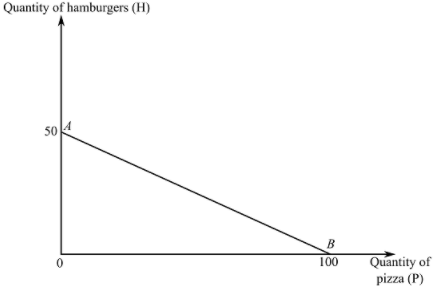 |
In the graph, the quantity of H is on the y-axis and the quantity of P is on the x-axis. Point A is the y-axis intercept of the BL and point B is the y-axis intercept of the BL. AB is the BL of Person P.
d. The graph of indifference curves (ICs) of Person P is given below. As P and H are PS, the ICs are straight lines and parallel to each other. Each IC gives a specific level of utility to Person P.
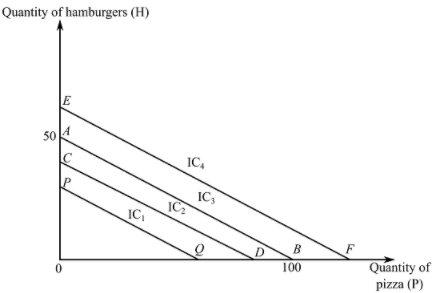 |
In the graph, the quantity of H is on the y-axis and the quantity of P is on the x-axis. The different ICs are IC1, IC2, IC3, and IC4. The IC that maximizes the utility of Person P is the one that is tangent to AB (budget line of Person P). So, the IC3 is the utility maximizing IC for Person P.
e. Person P is a utility maximizer.
So, the optimization problem of Person P is given as follows:
The objective function:
Maximize U(P,H) = P + 4H
Subject to the budget constraint:
P + 2H = 100
f. Solve the objective function:
MUP=∂U(P,H)∂P⇒MUP=1MUH=∂U(P,H)∂H⇒MUH=4MUPPrice of P=13⇒MUPPrice of P=0.33(approx.)MUHPrice of H=46⇒MUHPrice of H=0.67(approx.)
As 0.67 > 0.33, Person P will spend all his income on good H. This is because P and H are PS, so the utility maximizer will consume the good that gives Person P the highest marginal utility of money (MU/P).
So, Person P will only buy H.
The number of H bought = income of Person P/ price of H = $300/$6 = 50 units.
The number of P bought = 0.
So, by consuming 50 units of H and 0 units of P, Person P will maximize his utility.

